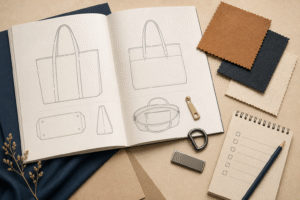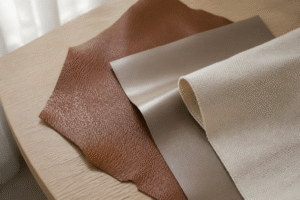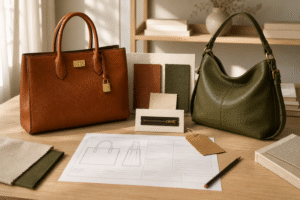
Cover image source: AI-generated editorial illustration created for this article (not a Katehandbag factory photograph). Copyright complaint / request image removal: kate@katehandbag.com. 侵权投诉请邮件联系,核实后删除图片。
How much does a custom handbag cost?
There is no single unit price that fits every programme. OEM/ODM cost is built from materials, hardware, construction, packing, and how many units you order per style. Factories quote against a brief—not against a generic catalogue number.
If you are comparing suppliers, ask for a breakdown tied to your sketch, material board, and target quantity. That is the only way to compare quotes fairly.
What drives the unit price
Face material and lining
Leather, PU, coated fabric, and technical textiles sit in different cost bands. Weight, hand-feel grade, and whether the lining is plain, printed, or branded all change the bill of materials. Confirm material names and specs early so the quote matches what you expect on the sample.
Hardware
Zippers, buckles, rivets, logo plates, and custom-shaped parts add cost by metal type, plating, and whether molds or dies are needed. Standard catalog hardware is usually cheaper and faster than custom tooling. Tooling and molds are typically quoted separately from the unit price.
Construction labor
Panel count, pocket complexity, stitching density, edge paint, and assembly sequence drive sewing time. A structured tote with multiple compartments costs more to build than a simple pouch of the same size. Labor is also why “same looking” bags can quote very differently once you open the construction sheet.
Packing
Polybag only, tissue, cardboard insert, dust bag, hangtag, and carton marking all sit on top of the bag cost. Export packing for retail-ready presentation is not the same as bulk unbranded packing—state which you need in the brief.
Quantity band
Unit price usually improves as order quantity rises within a style, because cutting, setup, and material purchase amortize better. Very small runs carry higher unit cost. Larger programmes are quoted to brief once style and materials are locked.
MOQ: from 500 pcs per style
Our site MOQ starts from 500 pcs per style. That threshold exists because pattern setup, material purchase, and line changeover need a workable run length.
Larger programmes (multi-style or higher volume) are quoted to the brief. Do not assume a fixed MOQ of 1,000 across every enquiry—send target quantity and we will confirm what is workable for that construction and material.
Why unit price moves with quantity
- Material purchase: mills and leather suppliers often price better at higher yardage or hide volume.
- Cutting and sewing setup: the fixed time to set jigs and stations spreads over more units.
- Hardware and accessories: small lots of custom or plated parts cost more per piece.
- Packing and carton: fewer cartons and less mixed packing reduce handling cost per bag.
When you request quotes at two quantity bands (for example 500 and 1,000+), you can see how sensitive your style is to volume.
Tooling and molds (separate line)
Custom logo molds, die-cut shapes, and special hardware tooling are usually quoted as a separate charge—not buried inside the unit FOB. Ask whether tooling is one-time and whether it stays with your programme for reorders.
What to request in a quotation
Send (or ask the factory to confirm) the following so the quote is usable:
- Style reference — sketch, tech pack, or blank structure / factory sample by style code
- Size and capacity — L × W × H, strap drop, pocket list
- Face and lining — material type, thickness/weight if known, colour
- Hardware list — zipper brand preference if any, metal finish, logo method (deboss, foil, metal plate, woven label)
- Construction notes — edge paint, piping, structured vs soft, special stitches
- Packing — polybag, dust bag, hangtag, carton mark
- Quantity per style — target and optional second band
- Incoterms and port — typically FOB Shenzhen or Guangzhou
- Timeline — sample need-by date and bulk ship window
- Branding — private-label or unbranded; logo artwork if ready
Sample fees are quoted with the brief. Complexity and logo method affect sample cost—ask when you send the brief rather than assuming a fixed sample price.
Typical timeline (for planning, not a promise)
- Sampling: typically about two weeks after specs and materials are locked
- Bulk: typically about two months FOB after sample approval and order confirmation
- Ports: Shenzhen or Guangzhou
Primary production path is our Huadu floor in Guangzhou. Private-label and unbranded programmes are both OK.
Next step
Send your style codes or sketches, target quantity, and material preferences. We will return a quotation aligned to your brief.
Request a quotation / sample styles: kate@katehandbag.com · View sample styles · Request a quotation
WhatsApp Business: +86 13580941730
Ask for sample styles and a quotation when you are ready to move.